
Unknown Sandbox · Phase One Proposal
A student dashboard, a guided diagnostic wizard, a v1 project memory, and an Unknown‑branded vibe coder. So every project starts with a clear problem, customer, and a first live site, instead of a blank page.
Written for Thomas and the Unknown team. A focused first build, scoped small on purpose, on infrastructure that's already underway, so we can launch a pilot in the first week of June.
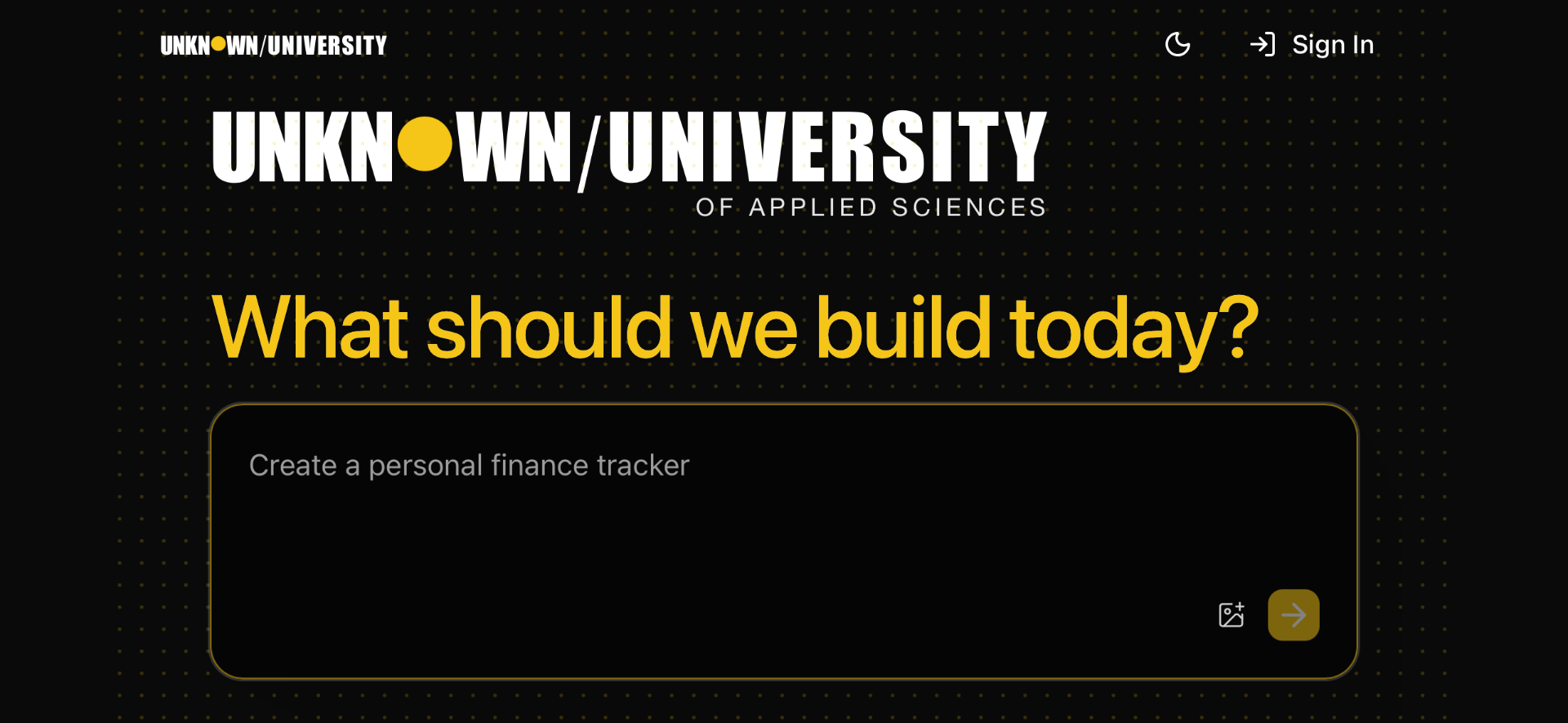
What Unknown Sandbox is
A sandbox environment for Unknown students to think, build, and ship inside one place, with a coach (later, an AI one) looking over their shoulder.
A guided diagnostic
A vibe coder
One project memory
Room for more tools later
Phase One is a deliberately small slice of this. The rest is sketched out below so we can build the slice in a way that doesn't block it.
What we actually build now
Four concrete deliverables. Nothing else in this phase.
Student dashboard
- One dashboard per student, listing all their projects, branded as Unknown Sandbox.
- From any project: enter the diagnostic wizard, jump into the vibe coder, or view and edit the project memory.
- Unknown YouTube embeds on the side, so the dashboard feels populated and learning happens in context, before any extra tools get added later.
Diagnostic wizard (the pre‑flight)
A guided wizard that walks the student through:
- Idea and origin
- Problem
- Customer segment
- Value proposition
- Strategy and channels
- Business model
- Pricing
- Users, roles and UI needs
- Competition and positioning
- Brand basics: name, tone, feel
They can step through it properly, or skip with a clear warning: if you skip this, the quality of your site is on you. The output becomes the first version of their project memory, and either flows straight into the vibe coder or saves for later.
Project memory (v1)
- Stores key facts and assumptions: problems, customer, pivots, partnerships, decisions.
- Editable by the student, so we don't keep hallucinating last year's partnership or a pivot they already abandoned.
- Viewable and editable inside the sandbox.
- Designed to be read by other tools later (coach, canvases, research) without rework.
Vibe coder (Phase One builder)
- Reads the project brief and memory, generates a first landing page or small site.
- Perfect for landing pages, but capable of building more complex apps too.
- Students can also build apps with their own AI capabilities by connecting their own AI API key.
- Students can tweak copy and structure directly.
- Publishes to a preview URL so they can share it the same day.
That's it for Phase One. No coach avatar, no canvases, no messaging integrations, no exports. Those are sketched in Phase Two so we build Phase One in a way that doesn't block them.
Cloudflare now, AWS optional later
Start where things already work. Keep the AWS option open, but be honest about what it costs us in setup.
Cloudflare (where we start)
- Workers, Durable Objects, Containers and R2: the stack the prototype already runs on.
- Runs under our account. Students don't have to set anything up to use the sandbox.
- We've already built this stack, which is why we can hit a June pilot.
- Simple to operate, fast to ship, costs are predictable: the right default for Phase One.
AWS (the credits option, Phase Two)
- Unknown can pull AWS credits per student (around 10K each), and we'd love to use them.
- But running this per‑student on AWS is tremendously complicated: every student would need a registered business, a business email, and their own AWS account set up before they could touch the sandbox.
- That's a non‑starter for a pilot. Cloudflare doesn't require any of that.
- Phase Two option: once Phase One has proven itself, we scope an AWS migration (or dual‑run). Same workloads run roughly 1.5–3× the Cloudflare unit cost, but credits absorb that easily.
For the Phase One pilot, build on the existing Cloudflare stack. We know it works, the costs are predictable, and there's no per‑student setup. In Phase Two, once the sandbox has proven its value, scope an AWS migration (or dual‑run) so we can spend student credits at scale.
What we want to run the pilot on
A simple operating budget for a one‑month pilot, on top of whatever Unknown offers as payment to us.
€500 for a one‑month pilot.
That covers everything the sandbox needs to run for the cohort:
- Cloud costs: Cloudflare Workers, Containers, Durable Objects, and R2 storage.
- AI that powers the vibe coder builder chat.
- AI that powers the diagnostic wizard, memory parsing and prompt generation.
- A reasonable amount of building and AI usage by students for the duration of the pilot.
Container sizing
After the pilot
- Auto‑sleep on preview containers after short idle, with a hard cap on concurrent previews per project.
- Per‑project monthly AI budget with soft warnings to the student before any limit is hit.
- Premium AI features gated behind a toggle, off by default.
- Where possible, students can connect their own AI API key for heavier usage.
Total = Unknown's payment to engage us for the build and pilot + the €500 operating budget. Both lines are needed: the payment funds the work, the €500 funds the running of the sandbox itself.
- Operating budget: €500, covers all infrastructure, AI usage and student usage during the one‑month pilot.
- Student‑side overage: covered by the €500 operating budget, but students who want more usage can pay a small overage (you mentioned roughly €6/mo). Could also be a small subscription from launch.
How we run it with your students
- Recommended cohort size: 10–20 students. We'll size the infra and the budget to whatever you pick.
- At launch, a couple of onboarding sessions: walk students through the wizard, the memory, and the builder. After that, they run free with it.
- One Unknown staff member sits in on the onboarding sessions and gets trained alongside the students, so Unknown can support them after we step back.
- What we watch over month 1: wizard completion rate, projects shipped (sites live), where students get stuck, and where the cost meter actually lands vs the model.
- Use what we learn to shape the flows, the costs, and the role of the coach avatar before we widen it out.
What we're not doing in Phase One: weekly group sessions or coach‑avatar workshops. Those come once Phase Two adds the coach.
From sign to launch
If we move quickly on sign‑off, we launch the pilot with your first cohort in the first week of June.
If sign‑off slips, launch slips by the same amount.
Where this can go after the pilot
Sketched here so we can build Phase One in a way that doesn't block any of it. Not part of this build.
A real coach avatar with personality
A multi‑tool dashboard
Cross‑auditing canvases
Messaging integrations
Competition research, built into the diagnostic
Export and graduation
Wider rollout
AWS migration
NotePhase Two is not part of the Phase One build. It's here so we design Phase One in a way that leaves room for it.